
Best AI Tools 2026: Top Artificial Intelligence Tools for Productivity, Business & Content Creation
Discover the best AI tools of 2026 for business, content creation, coding, marketing, productivity, and automation. Explore top artificial intelligence platforms that can help you work smarter, save time, and boost efficiency.

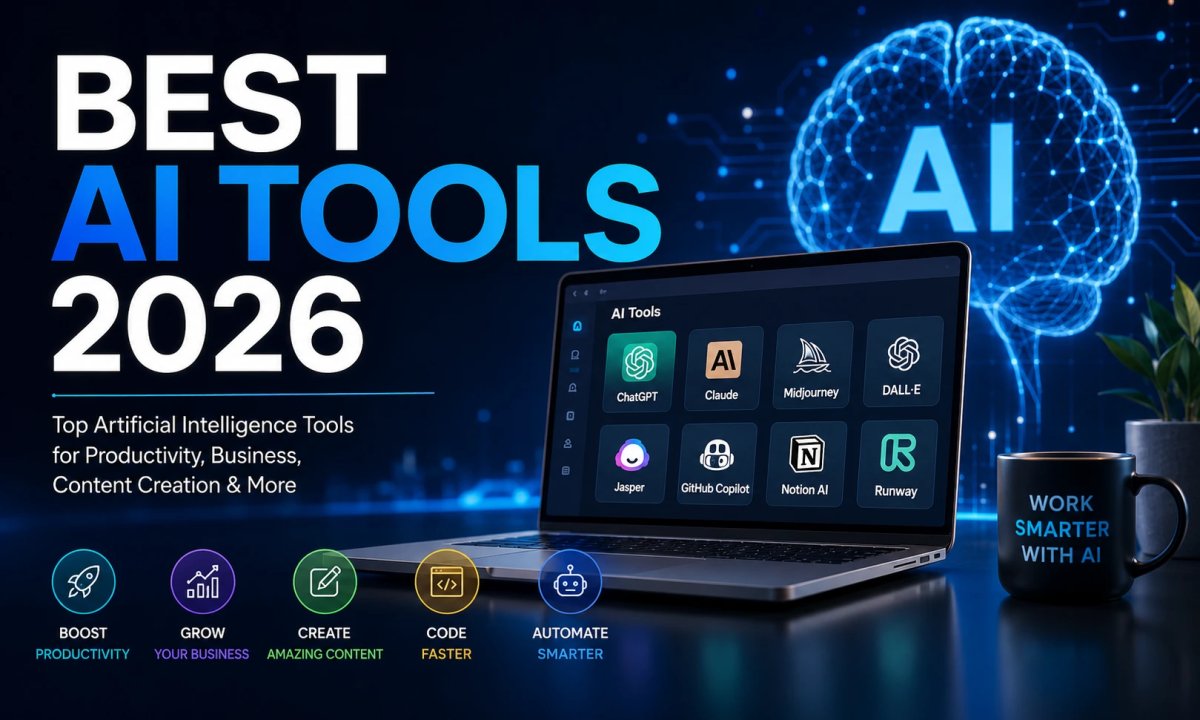
Best AI Tools 2026: The Ultimate Guide to the Top Artificial Intelligence Tools for Work, Business, Content Creation, Coding, and Productivity
Introduction
Artificial Intelligence has transformed from a futuristic concept into an essential part of everyday life. In 2026, AI tools are helping businesses automate repetitive tasks, creators generate high-quality content, developers write code faster, marketers optimize campaigns, and students learn more efficiently than ever before.
The AI revolution is no longer limited to large technology companies. Small businesses, freelancers, entrepreneurs, educators, and even casual users now have access to powerful AI solutions that were once available only to enterprise organizations.
The biggest question in 2026 is no longer whether you should use AI. The real question is:
Which AI tools are worth using?
With hundreds of AI platforms available, choosing the right one can be overwhelming. Some tools specialize in writing, others focus on image generation, coding assistance, video creation, marketing automation, customer support, data analysis, or business productivity.
This comprehensive guide explores the best AI tools of 2026, their features, benefits, pricing considerations, and ideal use cases.
Why AI Tools Are Essential in 2026
AI adoption continues to grow across industries because it provides measurable advantages.
Benefits include:
-
Faster task completion
-
Reduced operational costs
-
Increased productivity
-
Better decision-making
-
Improved customer experiences
-
Enhanced creativity
-
Scalable business operations
Companies using AI effectively can often accomplish in hours what previously required days of manual effort.
Whether you're a freelancer, startup founder, marketer, developer, student, or enterprise executive, AI tools can help you work smarter and achieve better results.

What Makes a Great AI Tool?
Before selecting any AI platform, consider the following factors:
Ease of Use
The best AI tools offer intuitive interfaces that require minimal training.
Accuracy
Reliable outputs are critical for professional use.
Automation Features
Automation saves time and reduces repetitive work.
Integration Capabilities
Top AI platforms connect with popular business applications and workflows.
Security and Privacy
Data protection is increasingly important in the AI era.
Cost Effectiveness
A tool should provide substantial value relative to its subscription cost.
Best AI Writing Tools in 2026
1. ChatGPT
ChatGPT remains one of the most popular AI assistants worldwide.
Key Features
-
Content creation
-
Blog writing
-
Email drafting
-
Coding assistance
-
Research support
-
Business planning
-
Language translation
Best For
-
Bloggers
-
Students
-
Professionals
-
Marketers
-
Businesses
Advantages
-
Highly versatile
-
Easy to use
-
Strong reasoning capabilities
-
Supports multiple industries
Use Cases
-
Writing blog posts
-
Creating social media content
-
Generating marketing copy
-
Drafting reports
-
Brainstorming ideas

2. Claude
Claude has become a leading AI assistant for long-form content creation.
Features
-
Long document processing
-
Research analysis
-
Content summarization
-
Professional writing assistance
Best For
-
Researchers
-
Writers
-
Consultants
-
Enterprises
Advantages
-
Handles large documents efficiently
-
Produces natural writing
-
Strong contextual understanding
3. Jasper AI
Jasper continues to dominate AI marketing content creation.
Features
-
SEO content generation
-
Advertising copy
-
Brand voice customization
-
Marketing workflows
Best For
-
Marketing teams
-
Agencies
-
Content creators
Benefits
-
Consistent brand messaging
-
Faster content production
-
Marketing-focused outputs
Best AI Image Generation Tools in 2026
Visual content remains one of the most valuable assets online.
AI image generators have improved dramatically.
4. Midjourney
Midjourney is known for producing artistic and visually stunning images.
Features
-
High-quality artwork
-
Realistic imagery
-
Creative concept generation
-
Professional-grade outputs
Best For
-
Designers
-
Artists
-
Content creators
-
Marketing campaigns
Advantages
-
Exceptional visual quality
-
Strong artistic control
-
Consistent outputs

5. DALL·E
DALL·E continues to evolve as a leading image generation platform.
Features
-
Text-to-image generation
-
Image editing
-
Object replacement
-
Creative visualization
Best For
-
Content marketers
-
Businesses
-
Social media managers
Benefits
-
Easy to use
-
Fast generation
-
High flexibility
6. Adobe Firefly
Adobe Firefly integrates AI directly into creative workflows.
Features
-
Generative design
-
AI-powered editing
-
Commercial-safe content creation
Best For
-
Professional designers
-
Agencies
-
Creative teams
Best AI Video Creation Tools in 2026
Video content dominates digital marketing.
AI tools now make video creation easier than ever.
7. Synthesia
Synthesia allows users to create AI-generated presenter videos.
Features
-
AI avatars
-
Voice generation
-
Multilingual support
-
Training videos
Best For
-
Corporate training
-
Marketing videos
-
Educational content
Benefits
-
No camera required
-
Fast production
-
Cost-effective
8. Runway
Runway is one of the most innovative AI video tools available.
Features
-
AI video generation
-
Motion editing
-
Object removal
-
Visual effects
Best For
-
Filmmakers
-
Creators
-
Agencies

9. Pika
Pika has become a favorite among social media creators.
Features
-
Text-to-video generation
-
Short-form content creation
-
Creative animations
Advantages
-
Beginner-friendly
-
Fast rendering
-
Creative flexibility
Best AI Coding Tools in 2026
Software development has been significantly accelerated by AI.
10. GitHub Copilot
GitHub Copilot remains one of the most powerful coding assistants.
Features
-
Code completion
-
Error detection
-
Documentation generation
-
Multi-language support
Best For
-
Developers
-
Software engineers
-
Startups
Benefits
-
Faster coding
-
Reduced debugging
-
Improved productivity
11. Cursor AI
Cursor has become extremely popular among modern developers.
Features
-
AI-assisted programming
-
Project-wide understanding
-
Smart debugging
Benefits
-
Enhanced workflow
-
Better code quality
-
Faster development cycles
12. Replit AI
Replit combines development and AI assistance into one platform.
Features
-
Browser-based coding
-
AI code generation
-
Team collaboration
Best For
-
Students
-
Startups
-
Freelancers
Best AI Productivity Tools in 2026
Productivity remains one of AI's strongest applications.

13. Notion AI
Notion AI helps users organize information more efficiently.
Features
-
AI note-taking
-
Task management
-
Document generation
-
Knowledge organization
Benefits
-
Better productivity
-
Improved organization
-
Faster workflows
14. Grammarly AI
Grammarly has evolved beyond grammar correction.
Features
-
Writing enhancement
-
Tone suggestions
-
Content optimization
Best For
-
Writers
-
Students
-
Professionals
15. Otter AI
Otter AI simplifies meeting management.
Features
-
Meeting transcription
-
Summary generation
-
Speaker recognition
Benefits
-
Accurate notes
-
Time savings
-
Better collaboration
Best AI Marketing Tools in 2026
Marketing teams rely heavily on AI.
16. Surfer SEO
Surfer SEO combines AI with search engine optimization.
Features
-
Content optimization
-
Keyword analysis
-
Ranking recommendations
Benefits
-
Better search visibility
-
Improved content performance
17. Copy.ai
Copy.ai specializes in marketing content generation.
Features
-
Ad copy creation
-
Email campaigns
-
Product descriptions
Benefits
-
Faster campaign creation
-
Increased productivity
18. HubSpot AI
HubSpot integrates AI across its marketing ecosystem.
Features
-
Lead generation
-
Customer segmentation
-
Automated campaigns
Best For
-
Businesses
-
Agencies
-
Sales teams

Best AI Tools for Businesses
Businesses are increasingly adopting AI to gain competitive advantages.
Top business applications include:
-
Customer service automation
-
Workflow automation
-
Predictive analytics
-
Sales optimization
-
Market research
-
Data analysis
Organizations implementing AI effectively often experience significant productivity gains and operational efficiency improvements.
How to Choose the Right AI Tool
When selecting an AI solution, ask:
-
What problem am I solving?
-
What is my budget?
-
Does the tool integrate with my workflow?
-
Is the output quality reliable?
-
Will it save time or increase revenue?
The best AI tool is not necessarily the most expensive one. It is the tool that delivers the greatest value for your specific needs.
Future of AI Tools Beyond 2026
The next phase of AI development will likely include:
-
Fully autonomous AI agents
-
Real-time multimodal intelligence
-
Advanced personalization
-
Improved reasoning systems
-
Industry-specific AI solutions
-
Greater business automation
AI will continue reshaping how people work, learn, communicate, and create.
Organizations that embrace AI early are likely to maintain stronger competitive positions in the coming years.
AI Tools for Students and Education
Artificial Intelligence is transforming education at every level. Students are now using AI to research topics, create study notes, solve complex problems, improve writing skills, and prepare for exams more effectively.
Benefits of AI for Students
-
Faster research and learning
-
Personalized study plans
-
Better note organization
-
Improved writing quality
-
Instant explanations of difficult concepts
-
Enhanced productivity
Popular Educational AI Tools
Khanmigo
Khanmigo helps students learn through guided conversations rather than simply providing answers. This approach improves understanding and critical thinking.
Quizlet AI
Quizlet uses AI to generate flashcards, quizzes, and personalized study sessions based on learning progress.
Socratic
Socratic helps students understand homework questions by providing explanations and educational resources.
How Students Can Use AI Responsibly
While AI can be an excellent learning assistant, students should use it to understand concepts rather than replace genuine learning. AI works best when it supports education instead of becoming a shortcut.
AI Tools for Small Businesses
Small businesses are among the biggest beneficiaries of AI technology in 2026.
Previously, many business tasks required expensive software or large teams. Today, AI allows small businesses to compete with larger organizations at a fraction of the cost.
Key Business Areas Improved by AI
Customer Support
AI chatbots can answer common customer questions 24/7, reducing support costs and improving customer satisfaction.
Marketing
AI tools help businesses:
-
Create social media posts
-
Generate email campaigns
-
Design advertisements
-
Analyze marketing performance
Sales
Sales teams use AI for:
-
Lead scoring
-
Customer outreach
-
Follow-up automation
-
Sales forecasting
Operations
Businesses automate repetitive tasks such as:
-
Data entry
-
Appointment scheduling
-
Inventory tracking
-
Report generation
AI Tools for Content Creators
Content creation remains one of the most popular applications of AI.
Creators across YouTube, blogging, podcasting, and social media use AI to produce more content in less time.
AI for Blogging
AI assists bloggers with:
-
Topic research
-
Outline creation
-
Article drafting
-
SEO optimization
-
Content repurposing
Benefits
-
Faster publishing
-
Improved consistency
-
Better search rankings
-
Reduced writer's block
AI for YouTube Creators
YouTube creators increasingly rely on AI tools for:
-
Script writing
-
Thumbnail generation
-
Video editing
-
Voiceovers
-
Content planning
Advantages
-
Lower production costs
-
Faster content creation
-
Increased output volume
AI for Social Media
Social media managers use AI to:
-
Generate captions
-
Create visuals
-
Schedule content
-
Analyze engagement
-
Identify trends
The result is more efficient content marketing and better audience engagement.
AI Tools for E-Commerce
Online businesses are rapidly adopting AI to improve customer experiences and increase sales.
Product Description Generation
AI creates optimized product descriptions that improve conversions and search visibility.
Personalized Recommendations
AI analyzes customer behavior to recommend relevant products.
Benefits
-
Higher average order values
-
Increased customer satisfaction
-
Better retention rates
Customer Service Automation
AI chatbots handle common questions related to:
-
Shipping
-
Returns
-
Product information
-
Order status
This improves customer support efficiency while reducing costs.
AI Tools for Data Analysis
Data-driven decision-making has become critical for modern businesses.
AI-powered analytics tools help organizations:
-
Identify trends
-
Predict future outcomes
-
Analyze customer behavior
-
Improve operational efficiency
Benefits of AI Analytics
Faster Insights
Large datasets can be processed within seconds.
Improved Accuracy
AI identifies patterns that humans might overlook.
Better Forecasting
Businesses can make more informed decisions based on predictive analysis.
AI in Healthcare
Healthcare continues to be one of the most promising areas for AI innovation.
Applications
Medical Imaging
AI assists healthcare professionals in analyzing scans and identifying abnormalities.
Administrative Automation
Hospitals use AI to streamline scheduling, documentation, and workflow management.
Research
AI accelerates drug discovery and medical research processes.
Benefits
-
Improved efficiency
-
Faster diagnoses
-
Better patient outcomes
-
Reduced administrative burden
AI in Finance
Financial institutions increasingly rely on AI for risk management, fraud detection, and customer service.
Common Applications
Fraud Detection
AI identifies suspicious activity in real time.
Investment Analysis
AI assists investors by analyzing large volumes of market data.
Customer Support
Financial chatbots provide account assistance and answer routine questions.
Risk Assessment
Banks use AI to evaluate creditworthiness and lending risks.
AI in Human Resources
HR departments use AI to improve recruitment and employee management.
Recruitment
AI helps with:
-
Resume screening
-
Candidate matching
-
Interview scheduling
-
Talent acquisition
Benefits
-
Faster hiring
-
Better candidate selection
-
Reduced workload
Employee Development
Organizations use AI for:
-
Training recommendations
-
Performance analysis
-
Career planning
Challenges of AI Adoption
Although AI offers significant benefits, organizations should understand potential challenges.
Data Privacy
Protecting user data remains a top priority.
Companies should carefully review privacy policies and security measures before adopting AI tools.
Accuracy Issues
AI-generated outputs may occasionally contain inaccuracies.
Human review remains important for critical business decisions.
Implementation Costs
While many AI tools are affordable, enterprise-scale implementation may require significant investment.
Employee Training
Organizations must ensure employees understand how to use AI effectively.
Best Practices for Using AI Tools
To maximize value from AI, follow these best practices.
Start Small
Begin with one or two tools that solve immediate problems.
Measure Results
Track metrics such as:
-
Time saved
-
Revenue growth
-
Productivity improvements
-
Cost reductions
Maintain Human Oversight
AI should assist decision-making rather than completely replace human judgment.
Continuously Learn
AI technology evolves rapidly. Staying informed helps businesses remain competitive.
AI Trends to Watch in 2026
The AI industry continues to evolve at an extraordinary pace.
AI Agents
Autonomous AI agents are becoming increasingly capable of performing multi-step tasks with minimal supervision.
Examples include:
-
Scheduling meetings
-
Managing projects
-
Conducting research
-
Handling customer interactions
Multimodal AI
Modern AI systems can understand and generate:
-
Text
-
Images
-
Audio
-
Video
This creates more natural and powerful user experiences.
Industry-Specific AI
Specialized AI solutions are emerging for industries such as:
-
Healthcare
-
Legal services
-
Education
-
Manufacturing
-
Finance
These tools provide more accurate and relevant outputs.
Personalized AI Assistants
Future AI assistants will adapt to individual preferences, workflows, and goals.
Users will increasingly rely on AI companions for daily productivity and decision-making.
Common Mistakes When Choosing AI Tools
Many individuals and businesses make avoidable mistakes when adopting AI.
Choosing Based Only on Popularity
A popular tool may not be the best fit for your specific needs.
Ignoring Integration Requirements
Ensure the AI platform works with your existing software ecosystem.
Overlooking Security
Data privacy and compliance should always be considered.
Expecting Instant Results
Successful AI implementation often requires testing, optimization, and employee training.
Final Thoughts
Artificial Intelligence is no longer a luxury or experimental technology. In 2026, it has become a core component of productivity, business growth, content creation, software development, education, marketing, and customer engagement.
The best AI tools empower users to accomplish more in less time while maintaining high-quality results. Whether you are a student, entrepreneur, marketer, developer, creator, or business owner, there is an AI solution that can improve your workflow and help you achieve your goals.
As AI continues to evolve, the gap between organizations that embrace intelligent automation and those that do not will likely become even larger. Learning how to leverage the best AI tools today can provide a significant competitive advantage for the future.
The key is to start with the right tools, focus on measurable outcomes, and continuously adapt as new AI innovations emerge. By doing so, individuals and businesses can unlock unprecedented levels of productivity, creativity, and growth in 2026 and beyond.
Conclusion
Artificial Intelligence has become one of the most transformative technologies of our time, and 2026 is proving to be a landmark year for AI innovation. From content creation and software development to marketing, education, business automation, and customer service, AI tools are helping individuals and organizations achieve more with greater efficiency than ever before.
The best AI tools of 2026 are not just about automation—they are about enhancing creativity, improving decision-making, reducing repetitive work, and unlocking new opportunities for growth. Whether you're a freelancer looking to boost productivity, a content creator aiming to scale your output, a developer seeking faster coding solutions, or a business owner focused on increasing profitability, there is an AI tool designed to meet your needs.
As the AI landscape continues to evolve, choosing the right tools will become increasingly important. Focus on solutions that align with your goals, integrate seamlessly with your workflow, and provide measurable value. Remember that AI works best when combined with human expertise, creativity, and strategic thinking.
Organizations and individuals who embrace AI today will be better positioned to compete, innovate, and thrive in the future. By staying informed about the latest advancements and adopting the most effective AI technologies, you can gain a significant advantage in an increasingly digital world.
The future of AI is incredibly promising, and the tools available in 2026 are only the beginning. Start exploring, experimenting, and implementing the best AI tools today to unlock higher productivity, smarter workflows, and long-term success in the years ahead.
Frequently Asked Questions (FAQs) About the Best AI Tools in 2026
What's Your Reaction?
 Like
0
Like
0
 Dislike
0
Dislike
0
 Love
0
Love
0
 Funny
0
Funny
0
 Wow
0
Wow
0
 Sad
0
Sad
0
 Angry
0
Angry
0









Comments (0)